
When Weaker

It is a truth universally acknowledged that when you are winning you should simplify and when you’re losing you should complicate.
This is common chess logic, but it intrigued me to pursue the thought further and see whether it can be applied to the situation before the start of the game. What happens when you’re playing a stronger opponent and your “expected” score is to lose, i.e. you’re “losing” before the game has even started?
According to the logic above, you should strive to complicate the game from the start, but this isn’t always possible, nor desirable. While the opening is important in such cases, I have discovered that the state of mind with which one enters the game is much more so.
I will share experiences, thoughts and opinions that I have gathered through the years. This is a wide subject so my idea is to share the ideas and hopefully you can adjust them to your needs and use them in your practice.
There are two states of mind you can have before a game of chess: you are either afraid or you are not. It is especially important to be clear about this while in the process of preparation as everything that follows will depend on that. Naturally, it is better not to be afraid, but I have discovered that sometimes fear has motivated me as out of fear of missing something my play became more precise as I was in heightened prophylactic mode during the game.
Feeling fear is normal when playing stronger opposition, as the probability of losing is higher, but this isn’t a problem in itself. A problem arises when that fear dictates your decisions and prevents you from playing at your best ability in that particular game.
How do you overcome that fear? You can use it to motivate you, as I have done on many occasions. Or you can overcome it by any means you have discovered that work for you - NLP, meditation, autogenic training, going for a run, hitting the pillow are just a few random ideas.
The next step is to decide how and what to play based on how you feel. If you don’t have a wide repertoire then there aren’t really options here, but often one and the same opening can be played with a different state of mind and with different desired results. I have often played some very sharp stuff in the Najdorf with the idea to catch my opponent in a forcing line and kill off the game. So a sharp opening doesn’t mean you’re spoiling for a fight in the same manner as a calmer one doesn’t mean you just want to draw.
The choice of the opening also depends on the ability to guess your opponent’s intentions. He’s there to beat you, but how is he going to approach the game, is he going to go for theoretical lines or not? Furthermore, what strategy will be the most uncomfortable for him?
I often found that even highly theoretical players would play 1.Nf3 against me, aiming for a protracted, non-theoretical struggle. I took this as a sign of respect for my theoretical knowledge and preparation, so after a while I started to expect this approach and mentally prepared for a long, non-theoretical game.
However, there was one mistake I kept repeating in the past. It was the mental attitude of not being prepared for the game after my preparation finished. What would happen is that I would get my preparation in, I would obtain a satisfactory game, sometimes even a completely drawn one if that was my aim, but then as my opponent would continue to play I would fail to adjust to playing moves myself rather than reproducing them. The level of my moves would drop a lot, often I would blunder soon after my preparation ended. After many painful defeats I learned to prepare for this as well. I learned to expect that even if I manage to catch my opponent in my preparation he would continue to play and I must continue to make good moves if I wanted to avoid losing the game. When you’re weaker (even if you’re a Grandmaster) nobody will just give you a draw or let you off the hook easily.
Coming back full circle, feeling, or working towards, the mental toughness before the game is vital. It will then show in your moves and your opponent will feel it. If you feel strong inside, never yielding, and are ready to fight on equal terms until the end, you won’t lose. Very often your opponent will overpress and you will even win. That is how you beat higher-rated opposition. Except for Carlsen, there is always somebody who is weaker (at least on paper!) before the game. But that doesn’t mean anything as long as you don’t let the fear consume you.
To finish with, here’s an extreme example:
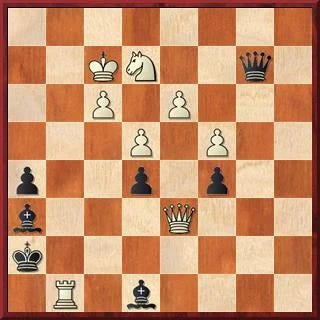
Playing Black against GM Maze from France at the Top 12 French teams in 2012 I misplayed the middlegame and was lost for a very long time. His last move was 44.Rg1xg8 and instead of just giving up I came up with the astonishing 44...Qd2!
During the game I thought I was still lost, but the engine disagrees, as surprising as it may seem! As I hoped, my move shocked him, he lost composure, missed a couple of wins later on as I missed draws and the game was eventually drawn on move 59.
Stronger players are also humans. They only have bigger ratings.
P.S. Today’s video is an analysis of a game of mine that had a decisive impact on my career. Seven long years passed since my first GM norm and I wasn’t sure whether I was ever going to make it to the title. The tournament in Malaga, in February 2005 came after I spent the whole winter studying Capablanca’s games using The Method (you can read about it following the link above) and it went amazingly well. My play was on a much higher level and 2 rounds before the end I was leading with 6/7. I needed only a draw for the GM norm. In the penultimate round I was outplayed, then missed a draw and eventually lost against Pia Cramling. The game in the video is the one from the last round. I suggest you take a look and feel free to shake your heads in disbelief.
Thank you for this insightful post.